Monday, January 23, 2006

CES: Get Your MoGo Mousing


The ultra-slim MoGo Mouse fits into your notebook's
PC Card slot for storage. Photos © Newton Peripherals

The 2006 International Consumer Electronics Show was full of strange sights and the MoGo Mouse Bluetooth wireless mouse from Newton Peripherals LLC was certainly one of them.
The MoGo resembles a conventional wireless mouse about as much as a globe resembles a fold-out map. Instead of a rounded shape, the $69.95 MoGo is flat and rectangular and is sized so it fits into a notebook computer's PC Card slot--a space often left empty now that many notebooks come with a modem, an Ethernet port and wireless networking already built in. While the mouse is parked in the slot it recharges its battery from the notebook's battery.
To use the MoGo Mouse, you pop it out of the PC Card slot and extend its plastic feet. In practice your fingers end up at the same angle they would be with a conventional mouse.
The appeal of the MoGo is that it relieves your travel bag of the clutter of a mouse on the loose. The caveat is that in order to use the MoGo, your notebook has to support Bluetooth wireless networking. While many new notebooks do, most do not.
Fortunately, adding Bluetooth functionality to a notebook or a PC isn't hard. Devices such as Belkin Corp.'s Bluetooth USB Adapter and Cisco Systems, Inc.'s Linksys Bluetooth USB Adapter USBBT100 plug into any USB port and are easy to configure. The MoGo Mouse will reach stores in the first quarter of 2006, according to Newton Peripherals.
Would you use this thing? Vote now.

Thursday, January 05, 2006

CES: Beep, Beep! I'm Over Here Bonehead!


Now why didn't I think of that? What happens when you forget where you parked your car? Wouldn't it be nice if your car could shout, "Over here you idiot!" or something just as endearing?

On Thursday Jack Conrad of Tabernash, Colorado won the $15,000 top prize in Digital Innovations LLC's first annual DOC Awards for design, originality and creativity. The award was presented at the 2006 International Consumer Electronics Show in Las Vegas.

The competition is for inventors who have not had their ideas mass marketed yet. Conrad's concept consists of a key ring device which activates a "horn tone" receiver in the car which responds with a prerecorded voice or with music or with an audio file created by the user. The concept is similar to that of creating ring tones for cell phones. You could record your own voice onto the receiver unit and have your car greet you as politely--or impolitely--as you would like.

Conrad, pictured at left below as he receives his award from Digital Innovations CEO Rick Mazursky, is now eligible for an exclusive worldwide licensing agreement with Digital Innovations, which makes a wide variety of accessories for consumer electronics and digital media.


Photo © 2006 Stadium Circle Features

CES: Babble: Hi-Tech Cone of Silence


Remember the "Cone of Silence" from the old "Get Smart" TV sitcom? By using a huge clear glass tube which would lower from the ceiling at the right moment, secret agent Maxwell Smart (played by the late Don Adams) could have a private, if kooky-looking, conversation with another agent.

Babble, a 2006 version of the Cone of Silence without the glass tube or secret agents, turned a few heads when it was shown off Wednesday by Sonare Technologies at the 2006 International Consumer Electronics Show in Las Vegas. The system looks like a conventional set of speakers, but offers a technology that can mask a person's voice, thus allowing him to speak on the phone or to someone nearby without the danger of other people overhearing the conversation.

Once you train the system to recognize your voice and the way you speak, Babble generates what sounds like crowd noise, explained Mark Schurman, director of corporate external communications at Herman Miller Inc., the parent company of Sonare. The noise is attuned to your voice and has the effect of masking what you're saying, thus thwarting eavesdroppers and allowing you to have a private discussion in an open area.

Babble won a "Best of Innovations" award at CES and was named a "Cherry Pick" for being one of the "newest and coolest" products at the show, as assessed by Marty Winston Public Relations.

Photo © 2006 Stadium Circle Features

Tuesday, December 27, 2005

2006 CES: Watch This Space


The 2006 International Consumer Electronics Show returns to Las Vegas January 5-8, 2006 and The Paper PC will be there. Check back here for updates on product announcements, photos from the show floor and for technology news as it breaks.

Since the demise of Fall Comdex, once the premier computing and technology showcase, CES has managed to pick up the slack and then some. This year CES spills out of the Las Vegas Convention Center and into the Sands Expo and Convention Center. As usual, the high-end audio exhibits will be at the Alexis Park Resort.

Much of the news at CES will be broken at pre-show press conferences and events. In this photo from the 2005 CES, Sirius Satellite Radio CEO Mel Karmazin makes his pitch to the press.

Do you have tips on what I should look for at the 2006 CES? Let me know at bob@paperpc.com. See you there!

Photo © 2005 Stadium Circle Features

Thursday, December 01, 2005

Turbo Charge: Grade AA Cell Phone Savior

If there's one thing you don't want to see in the middle of a long business travel day is the "low battery" warning on your cell phone. With luck--really bad luck--your phone charger will be miles away or packed with your luggage and you won't have a spare battery handy.

The chances that you will find the right battery for your cell phone at an airport newsstand or hotel convenience store are quite slim, but the odds of finding a store selling common AA batteries, even in the dead of the night, are probably quite good.

That's where the Turbo Charge from Voxred International LLC of Fairfield, New Jersey comes in. The silver-bullet-shaped Turbo Charge can bring a dead phone back to life with the aid of just about any type of AA battery. The Turbo Charge was shown at a New York preview event for the upcoming 2006 Consumer Electronics Show in Las Vegas (Jan 5-8).

The key feature of the $19.95 Turbo Charge, according to Voxred, is the unit's patent-pending Dual AlgorChip technology, which detects the power needs of the phone and delivers just the power that it needs, thus protecting the phone from overcharging. Included with the $19.95 unit is an adapter cord of your choice. Additional adapter cords are $2.95 each.

The body of the Turbo Charge isn't much larger than the single AA battery that fits into it. Using the Turbo Charge is simple: You insert an AA battery into one end, replace the end cap, insert the adapter cord into the other and then attach the entire assembly to your phone. A flashing blue light confirms that your phone is charging. If the battery doesn't have enough power left to charge you phone, the blue light goes out.

No, the Turbo Charge sure isn't the first cell phone charger to use AA batteries but it's definitely one of the smaller and more elegant-looking solutions.

Photo © Voxred International LLC

Monday, October 24, 2005

iDJ: An iPod mixer. Really.

Squeezed in between the electric guitars, electronic keyboards and other high-tech music gear at last weekend's Music Player Live! conference in New York was a nifty-looking mixing console that made many of the attendees do a double-take and then smile. Surely some of them must have thought the same thing: "Well why didn't I think of that?"

Instead of turntables, the $249 iDJ Mixing Console for iPod from Rhode Island-based Numark Industries LLC, comes with two empty docks with connectors designed for two Apple iPod digital music players.

While the iDJ wasn't the highest-tech device at the conference, it was arguably one of the coolest. All of the controls are backlit--a necessity if you're going to use the iDJ in a dark bar or club--and the blue glow only enhances the smooth lines of the white, blue and clear plastic that comprises the unit.

Since Apple Computer Inc. was wise enough to standardize the docking connector on most of its iPods, the iDJ can be used with anything from the video-enabled iPod to the diminutive iPod nano. You can also use it with other digital music player if you don't wiring them in.

If you really feel the need to scratch some vinyl, you can connect a turntable to one of the two audio input jacks. In fact, you can actually place the iDJ on top of a turntable--preferably a stationary one. There's a spindle hole on the bottom that lets you place the unit on top of one of the turntables of a dual-turntable mixer. Two large circular iPod touch controls let you control the docked iPods from the console and a USB port allows you to connect the unit to a Microsoft Windows-based or Apple Macintosh-compatible computer.

No it's not the highest-tech mixer on the block, but it sure looks like it would be fun to DJ a party with one. What do you think?

Photo ©Numark Industries LLC

Monday, October 10, 2005

Pop Goes the Speaker: Saitek's A-200

Your assignment: Design a portable speaker that lets you take room-filling, rich audio on the road without filling up your suitcase. You could stuff a couple small bookshelf speakers in your duffel bag, but where are you going to shove that big subwoofer?

Saitek, known for its joysticks and game controllers, solves the big-sound problem not with smoke and mirrors, but with thin air--with an assist from your hand.

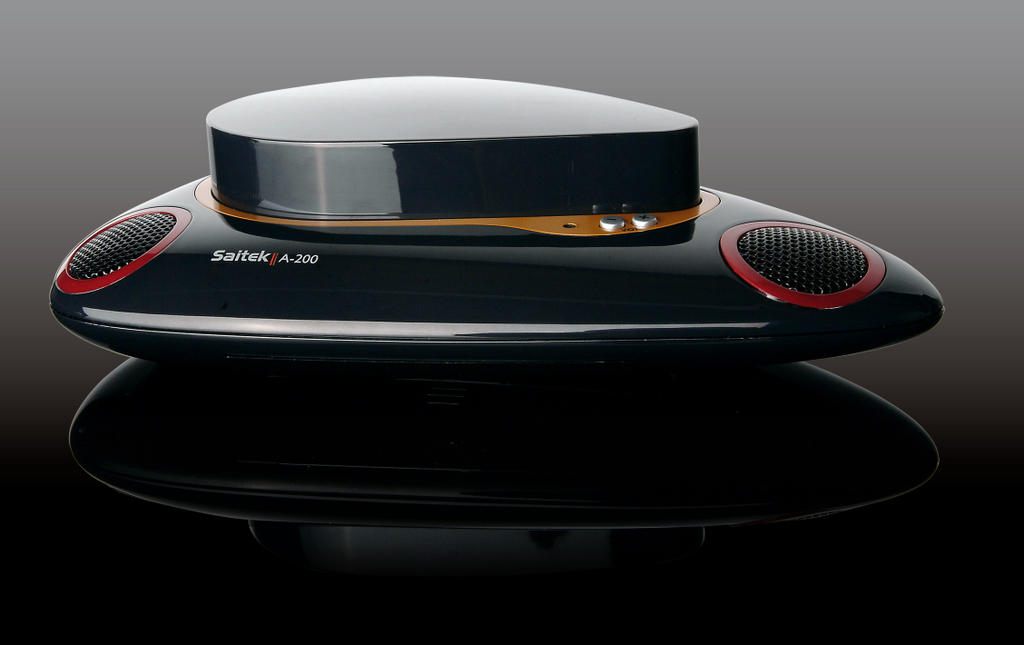
The new Saitek A-200 Portable 2.1 Speaker System ($99.95) looks unique enough with its boomerang-style curves but its most interesting aspect is its stowaway subwoofer.

When closed, the dark plastic section in the center of the A-200 is even with the rest of the unit. Push down firmly, however, and it unlocks and rises slowly and silently until it's an inch or so high. This creates an echo chamber above the bottom-mounted, three-watt subwoofer. This design, called the Expanded Air Volume System, is meant to enhance the bass produced by the subwoofer.


In practice the concept seems to work. When connected to an old Sony Walkman, the A-200 indeed yielded a rich and full-sounding audio that seemed to emanate from a much larger speaker system. The two top-mounted three-watt speakers provided ample stereo separation and the bass response was more than adequate. The design is clean and simple: Only an on/off LED and two volume buttons grace the top of the unit. The audio input and AC jacks are on one side.

So how does it sound once you push the air chamber back down? It's hard to say since closing the chamber shuts the A-200 off.

With a fairly compact triangular footprint, the unit could be used as a viable replacement for a conventional two-speaker-and-subwoofer setup for a PC. It can also be used to improve the audio from laptop-driven presentations. You can power the A-200 with four AA batteries or with the included AC adapter. Also included is a carrying case and a buffing cloth so you can keep the shine on the smooth plastic body.

No, it's not your father's speaker system, but that's probably a good thing. Would you give this one a try?

(Photos © Saitek)

Tuesday, August 30, 2005

Rio MP3 Player: Up the River


The Rio is dead. Long live the iPod.

Rio, the brand name that first made digital music players popular, will pass into history on September 30. D&M Holdings Inc., owner of the Rio brand, announced on August 26 that it would be getting out of the MP3 player business.

"The company's decision to exit the Rio business followed a determination that the mass-market portable digital audio player market was not a strong enough strategic fit with the company's core and profitable premium consumer electronics brands to warrant additional investment in the category," said the Tokyo-based company in a press release.

While Apple Computer Inc.'s iPod can lay claim to making the digital music experience simple and painless, it was the Rio PMP300, then manufactured by Diamond Multimedia, that introduced the cassette-tape- and CD-spinning world to portable digital music in 1998. However, after steady losses in market share, the end of the road for the Rio brand is now in sight.

The end came rather quickly. On July 26, just months after introducing the Rio Carbon (pictured above), D&M Holdings sold the technology behind the Rio players to SigmaTel, Inc., which makes the chipsets inside the players. However, even then the Rio Web site said that Rio players would continue to be marketed.

Is this the beginning of the end of the line for the rest of the iPod's competition? Not yet. The road for challengers will be tough, but other devices can compete by offering additional features.

For example, Giant International Ltd. plans to introduce the Tao Wireless Media Player (pictured to the right), an MP3 player with some nifty wireless capabilities, sometime this fall. In addition to a 20-gigabyte hard disk (enough for 5,000 songs) and an FM radio tuner, the unit also has an FM transmitter and a Wi-Fi wireless networking adapter.

The FM transmitter lets you listen to the music inside the unit on any FM radio, including your car stereo. You just need to set the unit to an unused FM frequency in your area.

The Wi-Fi adapter lets you download music into the unit without the need for a computer. Once you link with a Wi-Fi connection to the Internet, you can purchase and download music and audio books directly from online stores.

The Tao Wireless Media Player (suggested price $349.99) was shown at the Consumer Electronics Show in Las Vegas in January but is not expected to reach stores until this fall.

Is there room for iPod challengers? What do you think?

Monday, July 25, 2005

What a Shoq!


The Philips ShoqBox delivers on its promise of big sound
from a small box. Photo courtesy of Philips Electronics.

Raised eyebrows. That was my first reaction when I spotted Philips Electronics' ShoqBox digital music player/FM clock radio at a Philips press event in Manhattan in June.

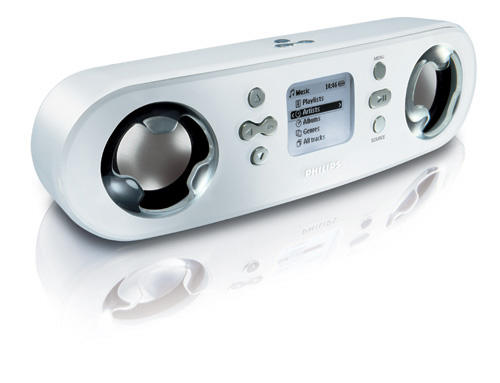
The unit, also marketed as The Personal Sound System, resembles a shiny white Twinkie with silver eyes. Even its zippered carrying case could double as a hot dog and bun holder. Despite the somewhat whimsical look, the unit does deliver much better sound than one would expect out of such a small package.

The ShoqBox comes with something you don't expect in a digital music player: speakers. When tested, the small titanium drivers easily filled a bedroom with rich, distortion-free music which sounded as if it was coming from much larger speakers. Two small port holes behind each speaker did indeed seem to enhance bass response.

ShoqBox model PS110 ($129.99), available now, comes with 256 megabytes (MB) of storage; enough for 60 songs in MP3 format or 120 songs in Windows Media format. Model PSS120 ($149.99) comes with 512MB of storage and will be available in September, said Philips.

A small monochrome liquid crystal display panel on the front of the ShoqBox keeps track of the song that's playing or the radio station that's tuned in. You can tune in radio stations manually or let the unit automatically scan the FM band and install the ten strongest stations as presets. Some of the fonts for the configuration menus are small, however, so keep your reading glasses handy.

The ShoqBox comes with Yahoo! Inc.'s MusicMatch Jukebox 9 music-management software (Version 10 isn't supported yet), but works fine with other music software like Microsoft Corp.'s Windows Media Player as long as you install the basic ShoqBox drivers in your PC.

Free firmware updates available on the Philips support Web site can add new functionality to the ShoqBox. For example, the ShoqBox I tested came out of the box with a 24-hour digital alarm clock. After I installed a firmware upgrade, however, a new item was added to the configuration menu which allowed me to switch between 24-hour and 12-hour AM/PM format.

Behind a flip-down plastic cover on the rear is a headphone/antenna jack, a line-in jack, a USB port and a power socket for the included AC adapter and charger. You can connect a notebook computer, CD player or other device to the line-in port and use the ShoqBox as a set of external speakers. The built-in rechargeable battery provides up to ten hours of operation per charge, according to Philips.

While the ShoqBox is fine for outdoor use, its shiny white case might make you think twice before you take it to the beach or anywhere where you might get it dirty or sandy.

Wednesday, June 22, 2005

Tivoli Audio: Satellite Yes, HD Radio No


Tivoli Audio showed off the new 2005 Fashion Collection
colors for its PAL (Personal Audio Laboratory) portable
AM/FM radios at a June 21 press conference in New York.
© 2005 Stadium Circle Features
Posted by Hello


HD Radio may have a future with the hundreds of radio stations that use the technology and with radio manufacturers like Polk Audio and Boston Acoustics Inc., but not with Tivoli Audio LLC--at least not for now.

During a June 21 press conference to announce new products, Tivoli Audio founder and CEO Tom DeVesto said his company wouldn't be enabling its products with HD Radio any time soon "...because I don't really see what the consumer benefit is."

Tivoli Audio is known for its high-end, conservative-looking table radios like the Model One. At the press conference at New York's St. Regis Hotel, Tivoli Audio showed off colorful new additions to its portable radio line and new table top radios.

When asked about HD Radio during a Q&A session, DeVesto said it didn't appeal to him. "There's no content that you can't get with analog radio," said DeVesto. "There's really no advantage that I see to the consumer today."

HD Radio technology allows existing radio stations to broadcast static-free digital radio programming using the same AM and FM frequencies they are now assigned. According to iBiquity Digital Corp, which developed and licenses HD Radio, the technology results in AM reception that has the fidelity of today's FM stations and FM reception with the clarity of a music CD.

HD Radio also allows stations to stream text data like weather and traffic reports along with their audio broadcasts. For example, during a music broadcast an HD Radio-enabled radio can display the name and artist of the song that is playing. HD Radio is free--no subscription is required--just an HD Radio-enabled radio.

DeVesto said today's FM stations, when tuned in with quality equipment, already provide better audio quality than what HD Radio promises. He also noted that the modules necessary to build HD Radio reception into a radio are expensive and only available through iBiquity. He said HD Radio might be more appealing when there is more unique content available.

At the press onference Tivoli showed off its limited-edition 2005 Fashion Collection colors for its PAL (Personal Audio Laboratory) portable radios. These weatherproof, rectangular units offer Tivoli Audio's trademark precision analog tuning dial and a 2.5-inch speaker. The speaker is monaural but a headphone jack offers stereo output. The $129 units have rechargeable batteries that offer up to 16 hours of playing time, according to the company. The 2005 Fashion Collection colors include sky blue, pink, orange and lime green.

The new $329.99 Tivoli Audio iSongBook, a slim, digital-tuning portable radio, offers a flip-down dock that accommodates Apple Computer Inc.'s iPod digital music players and a detachable second speaker. The 2.2-inch deep unit can run on AA alkaline batteries but also has a built in battery charger for nickel-cadmium (NiCad) or nickel metal hydride (NiMH) batteries. A small remote control unit controls the album and play list functions of a connected iPod. The second speaker can be attached to the right side of the unit or detached and connected with an included audio cable.

Also seen at the press conference was the $299 Model Satellite, which has a Sirius Satellite Radio receiver in addition to an AM/FM tuner. The sleek table radio is built into a cherry wood cabinet, offers a three-inch, top-mounted speaker and comes with a small remote control.